








Langtang Valley Trek - 10 Days

A scenic 10 days trek through the Langtang Valley. We are taking bookings for 2026, 2027
Langtang Valley Trek

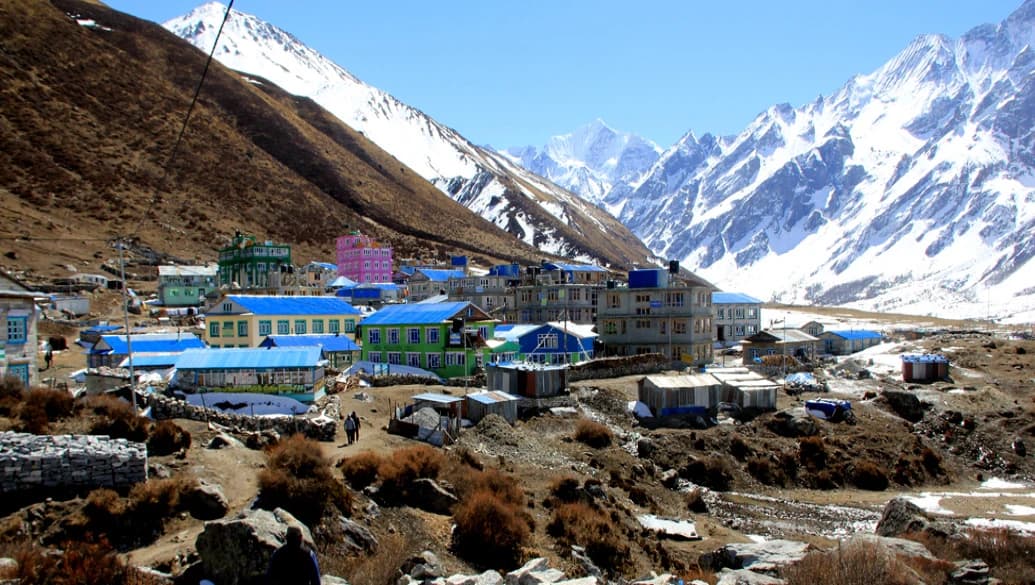
“The Langtang Valley Trek is a moderate difficulty trek that begins with driving from Kathmandu to Syabrubesi (the entrance to the Langtang Valley). The trek proceeds through Langtang National Park, Langtang Village and Kyanjin Gompa. Along the way, you will enjoy views of spectacular mountains, learn Tamang culture and history, visit ancient monasteries, and trek to Kyanjin Ri Peak.”

facts icon

What to see & do

Specific information about Langtang Valley Trek - 10 Days
duration icon
Duration10 Days
grade icon
Trip GradeModerate
i
altitude icon
Max Altitude5033m
start icon
Starts atKathmandu
end icon
Ends atKathmandu
travel-style icon
Travel StyleLodge to Lodge Trek
group-size icon
Group Size10
transportation icon
TransportationLocal Transportation
cloud-sun-rain icon
Best SeasonSpring and Autumn

Overview of the 10-Day Langtang Valley Trek

If you are seeking a stress-free Himalayan escape, our 10-Day Langtang Valley Trek itinerary is an ideal short journey, which provides exceptional views of the Himalayas, and an experience of local Tamang culture. The trek is graded to be moderately difficult, and suitable for beginners with no prior experience. It is an ideal option for people who want to explore the mountains of Nepal in a one week timeframe.

Our itinerary bypasses the stressful logistics and delays of domestic flight, starting instead with a raw, scenic 122-kilometer drive along the Pasang Lhamu Highway to Syabrubesi, the gateway to Langtang Valley. The trail is well-maintained, and passes through the Langtang National Park, and villages like Langtang Village (3,430 m/11,253 ft) and Kyanjin Gompa (3,870 m/12,696 ft). In this journey, you will experience vibrant local traditions, visit ancient monasteries, and hike to Kyanjin Ri (4,773 m/15,655 ft) for spectacular views of the Himalayan peaks.

During this first leg of the trek, walk through a steep, shaded gorge from Syabrubesi to Rimche and onwards to Lama Hotel. As you continue past Ghoda Tabela, the narrow trail opens up into a wide, alpine valley, revealing the massive glacial face of Langtang Lirung (7,234 m/23,734 ft). Walking into this section feels like entering a natural amphitheater of rock and ice, with spectacular views of Gangchempo (6,378 m/20,925 ft) and Dorje Lakpa (6,966 m/22,854 ft).

Beyond the dramatic scenery, the heart of this short journey lies in its profound cultural connection and story of human resilience. During the devastating April 2015 earthquake, the old Langtang Village was completely swept away by a catastrophic avalanche. Today, you will walk past the massive landslide debris field and a quiet memorial wall bearing the names of those lost. You will witness the incredible grit of the local Tamang people, who rebuilt their lives and homes in the settlements of Mundu and New Langtang Village.

Moving on, following the ancient trails decorated with water-powered prayer wheels, chortens, and carved mani walls, you arrive at Kyanjin Gompa at 3,870 meters. Here, you can immerse in Buddhist spirituality, visit an iconic monastery and taste fresh, nutty cheese from the local yak cheese factory established with Swiss support decades ago.

Online Trip Briefing

Once your reservation is confirmed and all your documents are received, we will send you an email with a link so we can schedule a time to talk that works best for you. And before you depart for your adventure, we will offer you a personal online briefing to help you prepare by explaining your packing list and what to expect daily on the Langtang trails. This will be an opportunity for us to share our local knowledge and help answer any additional questions so you can begin the journey confidently.

Highlights of the Langtang Valley Trek

  • Leave the chaotic noise of Kathmandu behind for a scenic ride along the Trishuli River, with stunning views of Ganesh Himal, to Syabrubesi.
  • Walk on quiet trails, passing the beautiful stone memorial, and connect to the inspiring spirit of the local Tamang families.
  • Spectacular views of Langtang Lirung (7,345m), Naya Kanga (5,846m), Gang Chhenpo (6,388m), Kimsung (6,781m), Dorje Lakpa (6,966m), and Yansa Tsenji (6,575m).
  • Spin wooden prayer wheels powered by rushing glacial streams and trace hand-carved mani walls along the trail.
  • Visit and explore the silent halls of Kyanjin Gompa, a sacred spiritual center for the local Tamang and Tibetan Buddhist communities.
  • Opportunity to spot wildlife, including the elusive red panda, and majestic Himalayan Tahr
  • Stand at the vantage point of Kyanjin Ri (4,773 m) or Tserko Ri (5,033 m) peak and enjoy panoramic views, including the majestic Langtang Lirung.
  • Explore the pristine Kimshung Glaciers, and hear the distant rumble of ice and water shift down the mountain valley.
  • Savor the taste of Himalayan Yak Cheese, an artisanal Swiss-style hard cheese at Kyanjin Gompa.

What are the Langtang Valley Trek Trail Conditions Like in 2026/2027?

The 122km road from Kathmandu to Syabrubesi has improved, with smooth asphalt stretches up to Bidur. However, you should still prepare for a 3km unpaved section at the “Ramche Landslide zone” just before Dhunche. Besides, while the main trail remains a moderate, well-paved path, ongoing construction near Sherpagaon means you will occasionally have to swap traditional paths for rough road sections.

Once you pass Ghodatabela, the forest landscape gives way to wide alpine grasslands. The trails lead you to the "New" Langtang Village, which was rebuilt about 100 meters higher than the original site for better safety against landslides and soil erosion. The teahouses here have moved beyond basic plywood construction to modern, earthquake-resistant designs with significantly better insulation and solar-heated shower systems.

Overall, you will find the path through the village wide and well-marked, characterized by vibrant prayer wheels and stable paths that lead through the alpine meadows toward the upper valley. Moving on, after reaching Kyanjin Gompa, you will notice the trails have been cleared of boulders, and with the addition of signage for better navigation. While the route to Tserko Ri remains a demanding stretch, the trail is well-traveled, making it well-maintained and stable.

Note: If you are traveling in the monsoon, the trails can be muddy and filled with leeches. It is best to pack durable hiking shoes, a gaiter, and salt to avoid irritating pests along the way.

How to Reach the Trailhead, What are the Transport Options?

The journey to Langtang starts at the Gongabu/Machhapokhari bus park in Kathmandu with a drive to Syabrubesi, the starting point of the trek. While most suggest the standard route via Galchhi, we recommend the Tokha-Dhikure route as a quicker alternative. You reach Syabrubesi in just 5–6 hours, compared to the 9-hour bus journey. This route is significantly steeper and narrower, but it can cut nearly 1.5 hours off your travel time.

Having said that, choosing the right transport option depends on your comfort, preference, and budget. The deluxe bus from Machapokhari costs around NPR 1,200–1,500 per person. Whereas the shared 4WD jeep costs NPR 2,000-2,500 per person. This option allows you to relax in comfortable seating and take frequent breaks to photograph Ganesh Himal and the surrounding scenery.

We suggest you wake up early, as the bus usually departs by 7:00 AM. On the other hand, a private jeep will come to pick you up at your hotel at a designated time. Be prepared for the countless twists and turns on the highway, and get yourself a prescription for medication if you have motion sickness. It will ensure you have a relaxing, enjoyable road journey to Syaburbesi.

Langtang Permit Updates and Info: What Do You Need for 2026/2027?

If you’re planning your trip to Lantang, one of the important things you need to know is that you can no longer travel solo in this region. Since the 2025 update to the regulation, you cannot physically pass the first major checkpoints without a licensed guide. This rule was implemented after a series of incidents in which travelers frequently got lost between the dense forests of Syabrubesi and Lama Hotel.

This means you’ll need to coordinate with a trek agency to register your documentation and obtain a permit to access the region. The permits will be verified at checkpoints like Dhunche and Syabrubesi. We recommend that you carry the physical copies of the documents in a waterproof sleeve for easier access. Here is a list of permits and papers needed for the Langtang Valley Trek.

  • Langtang National Park Entry Permit: NPR 3,390 (approx. $26, includes 13% VAT).
  • E-TIMS Card: NPR 2,000 (approx. $15, must be issued via a registered agency).
  • Original Passport: Required for verification at the Dhunche army checkpoint.

What is the Langtang Valley Trek Difficulty Level for Beginners?

The Langtang Valley route is a moderate trek with no technical mountaineering requirements. There are no icy glaciers to cross, no high-altitude mountain passes over 5,000 meters on the standard route, and absolutely no need for rope climbing, ice axes, or technical rock scrambling. If you have decent fitness and can handle walking with a light daypack for consecutive days, this journey is entirely within your reach.

The actual difficulty of the trek is determined primarily by two factors - steep elevation changes and uneven terrain. The next significant challenge will be on the second day (Syabrubesi, 1,503 meters), then continuing to the Lama Hotel (2,470 meters). This 11 km distance (between Syabrubesi and Lama Hotel) is an ascent of approximately 950 meters and will require approximately 6 hours of trekking time.

The real wild card for beginners is how their bodies adapt to high altitude. Once you settle into Kyanjin Gompa at 3,870 meters, the oxygen level drops, making even a short stroll feel twice as demanding. This is why we build a mandatory acclimatization day into our 10-Day itinerary, allowing you to rest, complete short guided side-hikes to Kyanjin Ri (4,773m) to help your red body adapt.

How do I plan my daily logistics for the Langtang Valley Trek?

Planning your trek through the Langtang Valley is just as important as being physically ready to hit the trail. To keep your journey smooth, safe, and cost-effective, you need to understand the logistics, local transport systems, and unwritten rules of the teahouses in the Himalayas. So for your convenience, here is the granular blueprint for managing your daily logistics.

  • Carry a buff or mask to protect yourself from dirt on the 3 km unpaved stretch known as the Ramche Landslide Zone near Dhunche.
  • Keep your original passport, visa copies, and printed permits easily accessible in your daypack. Your guide will need to present these to the military guards at the Dhunche Checkpoint, which serves as the official entry gate to the national park.
  • Keep in mind that as you ascend toward Kyanjin Gompa (3,870m), food resources must be carried up by mules and porters, meaning meals become costlier.
  • Order your dinner and breakfast in advance, as the teahouses have limited staff and cook meals from scratch over a central stove fueled by wood or dried yak dung.
  • Most upper teahouses rely on solar power, charging you NPR 200-500 ($2–$4 USD) per device. Skip the fees by carrying a 10,000-20,000 mAh power bank.
  • Be cost-effective by carrying a reusable, insulated thermos and filling it with tap water at guesthouses. Use a water purification tablet or a UV SteriPEN to treat it.
  • Buy a Nepal Telecom (NTC) SIM card in Kathmandu as it provides better signals and is more reliable at higher altitudes, working well up to Langtang Village and even Kyanjin Gompa.
  • Ask your guide to take the Sherpagaon via the Khanjim route. It starts with a steep, challenging incline from Syabrubesi but rewards you with stone-paved trails, gorgeous views of Ganesh Himal, and an incredibly quiet, uncrowded experience.

How Does the Langtang Seasonal Experience Change Throughout the Year?

If you talk to someone who has only walked the Langtang Valley in October, they will describe a world of crisp blue horizons and bustling, warm communal dining rooms. But if you ask a guide who has pushed through the silent, freezing fog of January or the humid, leech-heavy forests of July, you will get a completely different story. The truth is, Langtang’s unpredictable weather shifts so dramatically that your choice of month completely relates to your safety, your gear list, and the cultural interactions you’ll have along the trail.

Spring (March to May):The season starts cold with icy mornings, but by April, you’ll find yourself walking through legendary tunnels of red, pink, and white rhododendrons in full bloom, especially on the trail sections between Lama Hotel and Ghoda Tabela. The daytime temperatures are warm and comfortable, hovering between 10°C and 20°C in the lower forests, while Kyanjin Gompa averages a crisp 6°C to 12°C during the day. Nights are cool but rarely bone-chilling, making it much friendlier for those who struggle with the cold.

Autumn (September to November): Autumn is characterized by clear mountain views; during this time of year, it's incredibly green, and the alpine meadows are blanketed in late-blooming wildflowers. However, the lower forest trails below 2,800m remain wet and muddy, and leeches are still highly active. The temperature is similar to that of Spring, and by October, the weather is perfectly stable, and the trail and teahouses are heavily crowded. The payoff, however, is a festive atmosphere, as Nepal's major autumn celebrations, such as Dashain and Tihar, bring a joyful, celebratory energy to the local Tamang communities.

Winter (December to February): The Langtang Valley transforms into a pristine frozen sanctuary during winter. The bustling crowds completely vanish, leaving you to walk on quiet, snow-covered paths. The atmosphere is dry, removing all atmospheric haze, which means the peaks look impossibly close and brilliant against deep blue skies. Daily temperatures in the lower Langtang valley can reach +10°C, while Kyanjin Gompa can drop to -15 °C to -20°C at night. Besides, you must navigate frozen, slippery steps, and microspikes/crampons are highly recommended for the trails above Langtang Village.

Monsoon/Summer (June to August): Although trekking during Summer is doable, Monsoon is a muddy, humid, and highly challenging adventure that most travelers skip. The unpaved, winding roads from Kathmandu to the trailhead at Syabrubesi become incredibly unstable, and some sections are frequently blocked by heavy mudslides. The weather during your summer trek will be hot, with temperatures above 30°C (86°F). In July, the average temperature is 12.1°C with occasional downpour. So, we suggest you pack high-quality waterproof jackets, trousers, and boots to stay warm and comfortable on the trail.

How Can I Secure a Booking for Langtang Valley Trek?

Reserving your spot for a fully guided Langtang Valley trek is a straightforward process, but Nepal’s updated safety regulations mean you need to get your paperwork sorted early. Here is exactly how we handle bookings to ensure you are legally registered and safety-cleared before you even land.

First, you will want to secure your dates with a 10% advance deposit. You can handle this directly on our website, or use a bank transfer, Wise, or a credit card. Once your booking is confirmed, please submit the following four documents to us within a week:

  • A copy of your passport (valid for at least 6 months)
  • Passport-size photos (If you need a Nepali local SIM card)
  • Your travel insurance details (If you have)
  • Your flight information

We are a government-authorized trekking operator in Nepal with over 18 years of experience. And we have a vast network of connections with transport agencies, hotels, airlines, and more. So, all logistics for the trek will be sorted by us. Outfitter Nepal is also a proud member of the Trekking Agencies’ Association of Nepal (TAAN) and the Nepal Mountaineering Association (NMA). This means you will be legally accessing the Langtang region with authorization from Nepal government and local authorities.

Langtang Valley Trek - 10 Days Itinerary Outline

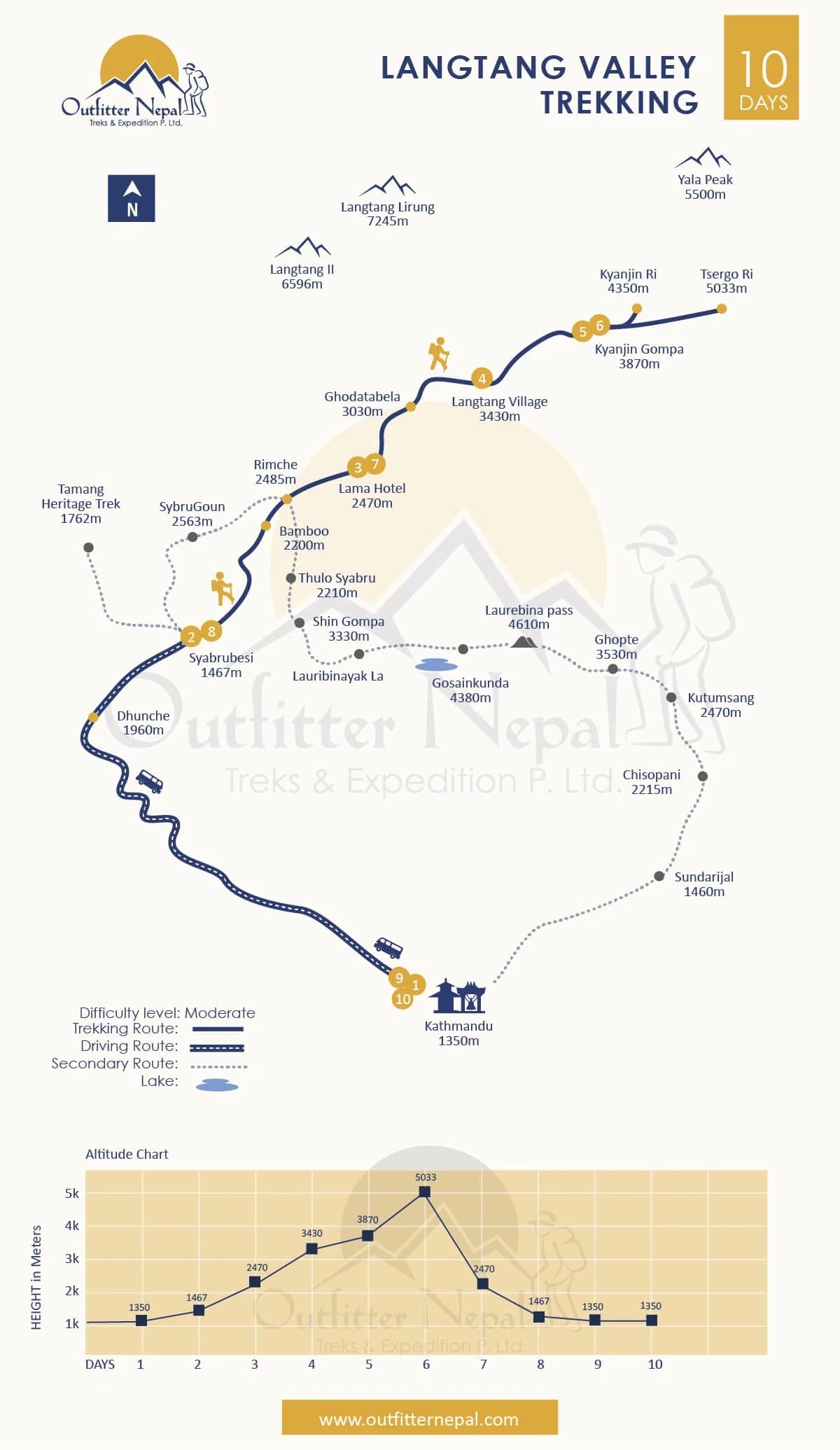
  • Day 01: Welcome to Kathmandu
  • Day 02: Drive from Kathmandu to Syabrubesi
  • Day 03: Trek to Lama Hotel from Syabrubesi
  • Day 04: Trek to Langtang village from Lama Hotel
  • Day 05: Trek to Kyanjin Gompa from Langtang Village
  • Day 06: Excursion around Kyanjin Gompa
  • Day 07: Trek back to Lama Hotel
  • Day 08: Trek to Syabrubesi from Lama Hotel
  • Day 09: Drive back to Kathmandu
  • Day 10: Farewell
Langtang Valley Trek Route Map

Cost Details

Good to know before trip booking

What's Included

  • Pick-up, drop-off and all airport transfers
  • Ground transportation by local bus from and to Kathmandu as per the itinerary
  • Accommodation for 2 nights in a 3-star category hotel in Kathmandu including breakfast
  • Accommodations in lodges on the trek
  • Required documents including Trekkers' Information Management Systems (TIMS) Card and National Park entry permit
  • Meals (breakfast, lunch, and dinner) as per the itinerary, including hot tea/coffee for breakfast.
  • Farewell dinner on the last evening in Kathmandu
  • A knowledgeable, first-aid trained and licensed guide who speaks fluent English
  • Wages, meals, lodging, transportation, medicines and insurance for the guide.
  • Sleeping bag, down jackets and duffle bag upon request (has to be returned after the trek)
  • Well-equipped first aid kit
  • Outfitter Nepal’s merchandise including t-shirt, cap, trekking map and Trip Achievement Certificate 
  • Arrangement for emergency rescue service to be covered through your travel insurance
  • All the government tax and administrative expenses

What's not Included

  • International flights
  • Nepal entry visa. Most tourists are issued a visa upon arrival at Tribhuvan International Airport in Kathmandu. It is an easy process. Please go through the  guide from the Department of Immigration for an overview.
  • Compulsory travel insurance 
  • Meals not mentioned in the itinerary 
  • Porter service is available at an extra cost. Hiring a porter costs USD 180. We allocate 1 porter for every 2 clients. Every porter has a weight limit of 20–22kgs. 
  • Expenses of personal kind that are not included in the itinerary
  • Laundry, telephone, hot shower & internet charges
  • Tips for the guide and staff
  • Anything that is not mentioned in the “Included” section

Dates & Prices

Book your trip with confidence
  • We have set date to departure the Langtang valley trek. So, select your date and book the trek.
  • If your preferred date is not listed then contact us for the further process to book on your own date as the trek is available on any date of the year.
  • We have listed the price for up to 10 people only so, if you are more than 10 people then please contact us for the group price and further process to book the trek.
  • Private trek is available on any date of the year, contact us for the booking.
  • Single persons are welcome to join the trek and single people have single room in Kathmandu and have to share room in the mountain lodge on trek cause of the less number of lodge and rooms available on remote mountain lodges.
  • Guaranteed dates are guaranteed to departure and we already have people booked for date.
  • Available dates are available to book and become guaranteed once you book for that date.
  • Closed dates are closed and not bookable on that date however if you are available only on that date then contact us as we may have some other alternatives.
  • The departure dates are your arrival dates in Nepal.

Upgrade and Options

Select a departure month

Showing Departures of Jun 2026
Starts: Friday
Jun 19, 2026
Ends: Sunday
Jun 28, 2026
Price (Per Person)
US$595
Availability
Guaranteed
Starts: Monday
Jun 22, 2026
Ends: Wednesday
Jul 01, 2026
Price (Per Person)
US$595
Availability
Guaranteed
Starts: Wednesday
Jun 24, 2026
Ends: Friday
Jul 03, 2026
Price (Per Person)
US$595
Availability
Guaranteed
Starts: Friday
Jun 26, 2026
Ends: Sunday
Jul 05, 2026
Price (Per Person)
US$595
Availability
Guaranteed
Starts: Monday
Jun 29, 2026
Ends: Wednesday
Jul 08, 2026
Price (Per Person)
US$595
Availability
Guaranteed

Detail Itinerary

Trip day to day detail itinerary
Day01

Welcome to Kathmandu

Upon your arrival in Kathmandu, our representative will pick you up at Tribhuvan International Airport. Experience a seamless transfer to your pre-booked hotel in Thamel. Check-in and freshen up. The rest of the day is at your leisure. If you arrive early, you can explore the surroundings on your own or choose a half-day sightseeing of Kathmandu with us.
Our team lead will meet you at the hotel this evening to brief you about the next day. Feel free to ask any questions or doubts that you may have with the team lead. Get a goodnight’s sleep because tomorrow will be an early start. 

  • max-altitude iconMax. Altitude: 1350m/4429ft
  • accomodation iconAccommodation: 3 Star Hotel
  • transportation iconTransportation: Private Vehicles
Day02

Drive from Kathmandu to Syabrubesi

After an early breakfast, our representative will pick you up at the hotel to catch a local bus to Syabrubesi. Local buses leave the station as early as 7 am. It takes 7 to 8 hours to get to Syabrubesi from Kathmandu.

The bus journey gives you the first taste of the scenic trekking experience ahead. The drive meanders along the Trisuli River on hairpin roads. During rafting season, the river sees white-water rafters fighting the rapids. You will also pass through small settlements, towns and villages along the route. Most of all, you will get your first glimpse of the Himalayas, mainly Manaslu, Jugal Himal, Ganesh and Langtang.  

From Trishuli Bazaar, the road stretching to Syabrubesi (65 km / 40 miles) is a bit bumpy but still filled with stunning vistas. The bus will stop for a few quick tea/coffee breaks, lunch and bathroom-breaks along the way. At Syabrubesi, we will check into a lodge for a much-needed comfortable sleep. 

Outfitter Nepal Tip: Private jeeps are more comfortable and faster than local buses. If you’d like to opt for a private vehicle, simply let us know. We can arrange a private jeep for you but it will cost extra.

  • max-altitude iconMax. Altitude: 1467m/4812ft
  • meal iconMeals: Breakfast, Lunch and Dinner
  • elevation-gain iconElevation Gain: 117m/383ft
  • accomodation iconAccommodation: Mountain Lodge
Day03

Trek to Lama Hotel from Syabrubesi

The first day on the trail is going to be relatively easy. After a nice breakfast, we will start the trek along Syabrubesi’s main road. The short trail takes you to the Ghopcha Khola. You will pass by terraced fields and climb through dense forests of oaks, maple, alder, and bamboo. The forest is home to yellow-throated marten, wild boar, langur monkey, red panda and Himalayan black bear. If you are lucky, you might be able to see them en route. 

The climb gets steeper from the forest to the Lama Hotel. Before reaching the destination you will cross over to the northern bank of the Langtang Khola via a suspension bridge. You will be surprised to know that the Lama Hotel isn't one hotel, but a collection of tea houses and lodges. We will settle down for the night at one of the finest lodges in the area. 

  • max-altitude iconMax. Altitude: 2470m/8104ft
  • meal iconMeals: Breakfast, Lunch and Dinner
  • elevation-gain iconElevation Gain: 1003m/3292ft
  • accomodation iconAccommodation: Mountain Lodge
Day04

Trek to Langtang village from Lama Hotel

After breakfast, we continue upstream of Langtang Khola on the trail towards Langtang village. The first stretch of the trek takes you through thick forests from where you will get the first glimpse of Langtang Lirung (7246m). A 3-hour trek after, you will reach Ghora Tabela or the Horse Stable which is our lunch stop. 

From here, the trail continues on a gentle climb, opening up to a valley of yak pastures and scattered Tamang villages. You will pass through traditional chortens, water mills, mani walls, before arriving at Langtang Village. The original village was destroyed by the 2015 earthquake and was desolate for a while. Now, the village is rebuilt and thriving again. 

We will sleep overnight in one of the comfortable hotels in the village. Enjoy the evening with a view of Langtang Lirung and Gonchompe and the glittering night sky.

  • max-altitude iconMax. Altitude: 3430m/11253ft
  • meal iconMeals: Breakfast, Lunch and Dinner
  • elevation-gain iconElevation Gain: 960m/3149ft
  • accomodation iconAccommodation: Mountain Lodge
Day05

Trek to Kyanjin Gompa from Langtang Village

Today is going to be a short hike before we reach our final destination, Kyanjin Gompa (3817m) on this trek. After breakfast, we continue on the trail which climbs gradually through small villages and yak pastures. You will come across many Tibetan structures, particularly chortens, prayer wheels, and religious rocks with inscriptions etched on them.

After 5 to 6 hours of hiking, crossing small streams and glacial moraines, you will reach Kyanjin Gompa. As the name suggests, the small valley houses the Kyanjin Monastery and also a few tea houses and a cheese factory. Besides these, the surrounding environs also offer breathtaking views of Dorje Lakpa (6966 m), Langtang Ri (6370 m), and Langtang Lirung (7205 m). While here, you can visit the cheese factory and explore the rest of the village, before calling it a night.

  • max-altitude iconMax. Altitude: 3870m/12697ft
  • meal iconMeals: Breakfast, Lunch and Dinner
  • elevation-gain iconElevation Gain: 440m/1444ft
  • accomodation iconAccommodation: Mountain Lodge
Day06

Excursion around Kyanjin Gompa

Today is an active rest day! After fueling up on breakfast, we have a laid back yet adventurous day exploring the landscapes around Kyanjin Gompa. A short hike leads us to the moraine, unveiling dramatic glacier views and icy faces of the mighty Langtang Lirung.

For those craving more stunning vistas, we can ascend Kyanjin Ri, the steep peak rising directly behind town. At 4,350 meters, it offers breathtaking panoramas of the surrounding Himalayan giants. If we're up for a longer challenge, Tsergo Ri beckons at 5,000 meters elevation. The 360 degree views from its summit showcase over 20 shimmering peaks, the Langtang Valley spread out below, and frozen alpine lakes.

Whatever our activity level, we'll unwind tonight back in the cozy village of Kyanjin Gompa.

  • max-altitude iconMax. Altitude: 5033m/16512ft
  • meal iconMeals: Breakfast, Lunch and Dinner
  • elevation-gain iconElevation Gain: 1163m/3779ft
  • elevation-loss iconElevation Loss: 1163m/3779ft
  • accomodation iconAccommodation: Mountain Lodge
Day07

Trek back to Lama Hotel

After breakfast, we will retrace the trekking trail that we came from and head back directly to Lama Hotel. Descending is fairly quicker and relatively easier than ascending. So, starting at Kyanjin we will follow the Langtang Khola to Langtang village, and back to Ghora Tabela. After lunch, we will continue on a steep descent to Lama Hotel where we will stay the night.

  • max-altitude iconMax. Altitude: 2470m/8104ft
  • meal iconMeals: Breakfast, Lunch and Dinner
  • elevation-loss iconElevation Loss: 1400m/4597ft
  • accomodation iconAccommodation: Mountain Lodge
Day08

Trek to Syabrubesi from Lama Hotel

Today is the last day of trekking for this 10-day Langtang Valley Trek. We hike back from Lama Hotel to Rimche, Bamboo, and finally to Syabrubesi. It will be short and easy, so enjoy every moment. Take time to appreciate the Himalayas and the villages on the trail back. Once at the trail-end, we will enjoy a delicious evening meal together before ending the night.

  • max-altitude iconMax. Altitude: 2581m/8465ft
  • meal iconMeals: Breakfast, Lunch and Dinner
  • elevation-loss iconElevation Loss: 111m/364ft
  • accomodation iconAccommodation: Mountain Lodge
Day09

Drive back to Kathmandu

After an early breakfast at the lodge, we pack up and depart the Langtang region around 7am, ready for the 8-hour drive back to Kathmandu. Retracing the scenic route from a week prior, we wind through mountain roads surrounded by Himalayan grandeur.

Upon arriving in Kathmandu, you can check into our hotel and finally relax. Enjoy a nice trekker’s massage or explore through Thamel's maze of tourist shops and restaurants. We will catch up for the farewell dinner in the evening.

  • max-altitude iconMax. Altitude: 1350m/4429ft
  • meal iconMeals: Breakfast, Lunch and Dinner
  • accomodation iconAccommodation: 3 Star Hotel
Day10

Farewell

The trip ends today. If you are flying out of Nepal, our representative will drop you off at the airport to catch your flight back home. 

If you are staying in Nepal for a longer period, let us know if you would like us to arrange for extra nights’ accommodation or other tours and trips. 

  • meal iconMeals: Breakfast
  • transportation iconTransportation: Private Vehicles
Customize Trip

Langtang Valley Trek - 10 Days Equipment Check List

We always tell our clients, packing for the Himalayas isn’t about bringing everything you own; it’s about bringing the right things. If you are packing for the 10-Day Langtang Valley Trek, you need to prepare for sudden weather changes on the trail. From the humid valleys of Syabrubesi to the thin, freezing air of Kyanjin Gompa, you will need to pack accordingly and layer your clothes to stay safe and comfortable.

Although the list of equipment and gears differs from your choice and interests as well, the list below is an introductory guideline for what you must have during the Langtang Valley Trek. You can either buy all these essentials in Kathmandu or rent them at a reasonable price.

Head

  • Sun hat (wide-brimmed)
  • Buff or neck gaiter (for sun protection and warmth)
  • Sunglasses with UV protection
  • Lightweight headlamp with adjustable brightness and extra batteries
  • Beanie (for warmth)

Upper Body

  • Thermal Base Layers (Merino Wool)
  • Moisture-wicking t-shirts (short and long sleeves)
  • Fleece jacket and down jacket
  • Waterproof and windproof jacket (Gore-Tex or similar)
  • Polypropylene underwear

Hands

  • Waterproof gloves
  • Insulated gloves or mittens

Lower Body

  • Insulated pants
  • Quick-drying pants/trousers
  • Lightweight cotton pants
  • Two pairs of thermal/trekking trousers
  • Thermal leggings or long underwear

Footwear

  • Broken-In Trekking Boot
  • Gaiters
  • Camp shoes, Sandals
  • Microspikes/Crampons
  • Thick Wool or synthetic moisture-wicking socks

Toileteries and Personal Care

  • High SPF sunscreen
  • Lip balm with SPF
  • Face wipes and hand sanitizers
  • Toothbrush and toothpaste
  • Biodegradable bar soap
  • Wet wipes or hand sanitizers
  • Toilet paper (In a Ziplock bag)
  • Dry Shampoo

Extra Items and Accessories

  • Adjustable and lightweight poles (We can provide you with these for complimentary usage)
  • Water bottle with a capacity of at least 2 liters
  • Water purification system (tablets, filter, or UV purifier)
  • Camera(extra memory cards and batteries)
  • Rechargeable power bank
  • A few passport-size photos
  • Passport photocopies
  • Binoculars
  • Swiss army

FAQs

Langtang Valley Trek - 10 Days frequently asked questions

General Information

The Langtang Valley Trek is situated in northern Nepal, winding through Rasuwa district right along the Tibetan border. The trail is entirely within Langtang National Park, Nepal’s first Himalayan protected area. To get there, you will drive north from Kathmandu to the gateway village of Syabrubesi, which serves as the official trailhead.

Langtang gives you raw Himalayan beauty and rich Tibetan Buddhist culture without the logistical headache of domestic flights. It is much quieter than Everest or Annapurna, meaning you won't have to fight for trail space.

The 10-day Langtang Valley Trek is includes 6 active trekking days and 2 overland travel days to and from Kathmandu, and 2 days for your arrival and departure. By spacing the ascent over 10 Days, we give your body the perfect timeline to acclimatize naturally without rushing.

The overland journey covers roughly 122 kilometers. While local buses are cheap, they take up to 7-8 hours and stop constantly. At Outfitter Nepal, we highly recommend booking a private 4WD jeep, which cuts travel time down to 5 or 6 hours.

The highest non-technical viewpoint is the summit of Tserko Ri (also spelled Tsergo Ri), standing at 4,984 meters (16,352 feet). It is a demanding, steep 6-to-7-hour round-trip hike from your base at Kyanjin Gompa.

The crown jewel of the region is Langtang Lirung, which towers directly over the valley at 7,227 meters (23,710 feet). While there are no peaks over 8,000 meters in the immediate valley, if you summit Tserko Ri on a razor-sharp morning, you can actually spot Mt. Shishapangma (8,027 meters) standing across the border in Tibet.

Because you are trekking through protected forests, you are entering a rich ecological sanctuary. Keep your eyes trained on the dense bamboo and oak forests between Syabrubesi and Lama Hotel. This specific damp, lower-canopy zone is the natural habitat of the endangered Red Panda. You are also highly likely to spot grey langur monkeys, Himalayan tahr grazing on high cliffs, and the brightly colored Himalayan Monal pheasant.

The Langtang trails are in excellent condition. Over the last year, local government has installed reinforced steel suspension bridges and carved stable, clear stone steps on the steeper climbs. There is no technical scrambling, exposure, or high-altitude passes on our standard 10-Day route. The primary safety focus is managing the daily elevation gain of 500 to 1,000 meters to avoid altitude sickness.

Yes, it is completely safe. The tragic avalanche triggered by the 2015 earthquake completely buried the original Langtang Village. However, the local Tamang community has shown incredible resilience. They have built beautiful, modern, seismic-resistant teahouses with insulated walls and cozy dining halls. Visiting the new village is one of the most direct ways you can support their local economy.

Definitely. If you have extra travel time and want a deeper adventure, our 10-Day itinerary is highly customizable. We can easily combine the classic valley trail with the rugged Tamang Heritage Trail for a deep cultural homestay experience, or cross the high Lauribina Pass (4,610m) to reach the sacred alpine lakes of Gosaikunda.

Trek Difficulty and Fitness Required

No, the National Park has officially banned solo and unguided foreign trekking in Langtang National Park. All foreign trekkers are legally required to hire a licensed guide through an authorized agency, such as ours.

Yes, this is one of the most accessible and beginner-friendly high-altitude routes in Nepal . Unlike the Everest or Annapurna Circuits, there are no extreme 5,000-meter mountain passes to cross. The elevation gain is steady and gradual, peaking at a maximum sleeping altitude of 3,870 meters at Kyanjin Gompa. If you can climb a few flights of stairs without getting winded or walk uphill for an hour without needing a long break, you can handle this trail.

This trip is rated "moderate" difficulty, roughly a 5.5 out of 10. It requires no technical mountaineering skills but demands good basic stamina to handle 5 to 8 hours of daily hiking. Having said that, the main challenges are steady, steep climbs and high-altitude risks.

There is no official age cap. We regularly guide families with children as young as six, as well as active seniors in their late seventies.

In order to allow yourself the best chance to enjoy the trip you will also need to develop both cardiovascular endurance and stability (strong lower body). We highly recommend starting your physical training 6 to 8 weeks before your trip. Focus on stair climbing, squats, and light jogging 3 to 4 times a week to build leg stamina.

Insurance and Visa

Yes, although not mandatory, travel insurance is necessary for the Langtang Valley Trek. It should cover high-altitude trekking (up to 5,000 meters), medical care, and helicopter evacuation.

Your policy must cover high-altitude medical treatment and emergency helicopter rescue. Helicopters in Nepal will not take off until they have guaranteed payment. Direct billing means the rescue company bills your insurer, relieving you of the financial burden. Also, ensure the policy covers hospital care in Kathmandu, not just the flight. Our team at Outfitter Nepal highly recommends World Nomads or True Traveler.

Most nationalities can easily obtain a Visa on Arrival at Kathmandu International Airport (TIA). Your passport must be valid for at least six months and have at least one blank page. The tourist visa fees are $30 USD for 15 days, $50 USD for 30 days, and $125 USD for 90 days. For our 10-Day trek, a 15-day visa is enough. However, we suggest buying the 30-day visa. It acts as a buffer against any road or weather delays.

Food and Drinks

Teahouse menus along this route are surprisingly diverse because the valley is so close to Kathmandu. For breakfast, you can order hot porridge, Tibetan bread, omelets, and black or ginger tea. Lunches and dinners feature momos, fried macaroni, pasta, pizza, and noodle soups. The ultimate mountain fuel, however, is fresh Dal Bhat. This traditional plate of rice, lentil soup, and vegetable curry is highly nutritious and always comes with free, unlimited refills.

We strongly advise sticking to a vegetarian diet once you leave Syabrubesi. Meat is carried up steep mountain trails by porters or pack animals, without refrigeration. By the time it reaches higher stops like Lama Hotel or Langtang Village, it is no longer fresh.

Do not miss the famous artisanal yak cheese in Kyanjin Gompa. The local dairy factory was established in 1955 under Swiss guidance and is a living piece of Himalayan history. Try their fresh, soft cheese in the morning, or buy a block of aged hard cheese to carry as a high-protein trail snack.

Never drink untreated tap, well, or river water on the trail, as it is not safe for travelers. While single-use plastic water bottles are sold along the route, they get expensive. Buying them also creates a massive plastic waste problem inside the fragile ecosystem of Langtang National Park. Instead, carry a reusable, insulated thermos bottle. You can buy safe, boiled water directly from your teahouses for a small fee. For additional safety, drop in a water purification tablet or use a portable UV filter bottle before drinking.

Weather Details

April and October are the peak travel months in this region. These months are characterized by clear skies, stable weather, dry trails, and beautiful landscapes. If you prefer warmer weather, May is a spectacular choice. The temperature rises to 25°C during the day, and with up to 15 hours of daylight, you get a highly safe, snow-free trail to attempt the challenging summit hike up Tserko Ri (4,984m) without needing any technical winter gear.

Daytime trekking temperatures are pleasantly mild, but high-altitude nights routinely plunge below freezing, dropping to -10°C in spring and autumn, and as low as -20°C during the winter months. We require all our trekkers to pack a professional four-season down sleeping bag rated to at least -10°C (ideally -15°C) along with an insulating liner.

In the Langtang region, mornings almost always follow a stable pattern of clear, calm skies and perfect visibility. By early afternoon, rising humidity often causes clouds and thick mist to roll up the river gorges, which can completely block views from Kyanjin Ri and reduce visibility on the lower trail. To ensure you get the absolute best views, our guides will have you on the trail by 6:00 AM or 7:00 AM.

Yes, trekking during the off-season is entirely possible and highly rewarding for those seeking isolation, provided you use experienced guides and make specific technical adjustments. The season of Winter (December to February) brings incredibly dry, crisp air with the sharpest mountain photography of the year, but the trail above Langtang Village is covered in heavy ice and snow. We navigate this by ensuring our clients have sturdy microspikes and trekking poles for trail stability. On the other hand, the Monsoon (June to August) is generally avoided, but with proper preparation, equipment, and guidance, you can complete the trek.

Information on Guide Requirements

Yes, tipping is a deeply respected and expected custom in Nepal’s trekking industry. It is an open and direct way to show your appreciation and gratitude to your trekking staff for the many hours they spend taking care of you and ensuring your safety while trekking through the Himalayas. We recommend you budget approximately 10% to 15% of your total trekking cost for tips.

No. Under Nepalese law, solo trekking without a guide is prohibited in Langtang National Park. Under Nepalese law, all foreign trekkers must be accompanied by a licensed guide registered through a certified agency. This is strictly enforced at army and park checkpoints along the trail, starting in Dhunche.

Yes, it is legally required. On February 5, 2025, the Langtang National Park Office and Trekking Associations’ Association of Nepal (TAAN) prohibited all unguided, foreign treks. You cannot obtain an individual TIMS card or enter the park boundaries on your own. Checkpoints at Dhunche and Syabrubesi are actively monitored by park authorities and the military. They will turn back anyone trekking without a licensed professional.

Every guide on our team speaks clear, fluent English. At high altitudes, clear communication is essential for safety. Your guide handles the check-in logs and translates from the local Tamang dialect. They also walk you through crucial local etiquette. For instance, they will remind you to always walk clockwise around Mani walls and chortens. If you need a custom meal or want to chat with the cheesemakers at Kyanjin Gompa, they handle the translation.

Choosing a porter is entirely up to your preference. They carry up to 24 kg of luggage (shared between two trekkers) in our custom duffel bags. This leaves you free to tackle steep stone staircases with just a light daypack.

Safety is the primary reason the government mandated the guide. The trail climbs steeply from Syabrubesi to Kyanjin Gompa at 3,870 meters. Our guides carry pulse oximeters to check your oxygen saturation and heart rate daily. They are trained to recognize the early signs of Acute Mountain Sickness (AMS) long before you feel them. Their expertise ensures we can immediately coordinate with Kathmandu-based helicopter rescue teams in the event of an emergency.

Required Permits

Yes, they are. Your 10-Day trekking package includes all necessary permit fees and administrative paperwork. We pay these fees directly to the Nepalese government authorities. You do not have to worry about extra costs. Our team prepares everything in Kathmandu, so your paperwork is ready the moment you arrive.

You need two main documents to enter this region. The first is the Langtang National Park Entry Permit, which costs NPR 3,000 plus a 13% government VAT, totaling NPR 3,390 (roughly USD 26). The second is the Trekkers' Information Management System (TIMS) card. Since you are traveling with us, your agency-supported TIMS card costs NPR 1,000 (about USD 8).

Yes, you can do solo but independent trekking is strictly banned in the Langtang region. The government mandates that all foreign travelers hire a licensed guide for safety. Under this rule, permit offices will not issue an individual TIMS card to a solo trekker. Outfitter Nepal must issue your TIMS card as a group permit under our official agency license.

We only need a clear, scanned copy of your passport photo page. You can easily upload this file through our secure online booking portal. Please ensure your passport is valid for at least 6 months from your arrival date. We also recommend bringing a few physical passport-sized photos. While rarely checked by the officers, they are incredibly useful for getting a local SIM card in Kathmandu.

Your guide will handle all physical registrations at the active checkpoints. The first major stop is the military checkpoint at Dhunche, where your park entry permit is logged. We also checked out of the park at the Ghoda Tabela checkpoint on our descent.

Langtang Valley Trek Cost

The cost for a 10-Day Langtang Valley Trek package typically ranges from $400 to $1250 USD per person. The price depends on group size, additional facilities, and services included.

The 10-Day package covers all logistics and essentials on the trail so you can enjoy the journey smoothly. It includes your airport transfers, round-trip transport, standard teahouse lodging, all mandatory permits (TIMS card and Langtang National Park Entry), and a government-licensed local guide. You also get three standard meals a day (breakfast, lunch, and dinner) while trekking.

We recommend carrying $15-$20 USD in cash per day, as there are no card readers or ATMs on the mountain. So, we suggest you exchange your currency in Kathmandu before we depart.

You will need additional cash for facilities along the trail. This includes a hot gas or solar shower ($2 to $5), phone charging ($1 to $3), Wi-Fi ($2 to $4), and boiled drinking water ($2 to $3).

Booking Process and Cancellation

Booking is simple. Pick your preferred date from our fixed departures list and click "Book Now". Our online system will guide you through the process. You will need to pay a 10% deposit to hold a place for you. You can pay this securely via credit card, Wise, bank transfer, or Western Union. The remaining 90% balance is paid in cash upon your arrival in Kathmandu.

Don't worry. Click the "Ask Question" button on our page or contact us directly on our WhatsApp and tell us your preferred dates. We will add your date to the system and email you a direct booking link. We also arrange private, custom departures on any date for solo travelers, families, and private groups.

Booking 4 to 6 weeks in advance is ideal. This gives us time to secure the best teahouse rooms during the peak spring and autumn seasons. However, we can handle last-minute bookings up to a few days before departure. Just make sure you arrive in Kathmandu a day early for our pre-trip briefing.

We understand that travel plans can change. Your 10% booking deposit is non-refundable but can be transferred to a future date if you need to postpone. For cancellations of the final balance, please check our detailed Terms and Conditions page. We strongly advise purchasing comprehensive travel insurance that covers trip cancellation and high-altitude emergency helicopter evacuation up to 5,000m.

Accommodation and Facilities

You will stay in local, family-run mountain teahouses along the trail. For our 10-Day Langtang Valley Trek, we provide five nights of accommodation with private attached bathrooms in Syabrubesi, Langtang Village, and Kyanjin Gompa. The other two nights at Lama Hotel are standard twin-sharing rooms with shared facilities. The bedrooms are basic and unheated, with thin plywood walls.

Yes, you can request a single room by paying the single supplement fee at the time of booking. We will do our absolute best to arrange this for you. However, keep in mind that space is extremely limited at higher elevations during peak months like October and April. In crowded stops like Kyanjin Gompa, you may have to share a room or sleep in the heated dining hall if the lodges are fully booked.

Both are available in most lodges for an extra fee. Mules and pack animals carry gas canisters to higher elevations, which makes hot water expensive. A solar or gas-heated shower costs between USD 3 to 5 (NPR 300–800) per session. Charging your phone or camera in the communal dining room costs about USD 2-4 per device. To save money, we recommend packing a 10,000 to 20,000 mAh power bank.

Most teahouses charge between USD 2 and 5 per day for local Wi-Fi, but the connection can be slow depending on the weather conditions. Rather than relying on lodge Wi-Fi, we suggest buying a Nepal Telecom (NTC) SIM card in Kathmandu. NTC provides decent 3G/4G data up to Langtang Village and works at Kyanjin Gompa on clear days.

Commercial laundry services are not available on the trail. You can wash small items, such as socks and undergarments, by hand in buckets of cold water. However, clothes take a long time to dry due to the cold, humid mountain air. We recommend bringing multiple pairs of moisture-wicking merino wool socks and quick-dry layers.

Health & Safety

No, but you must stay on the main route; most of the main trail along the river is well-marked and consistently traveled. However, the lower forest between Syabrubesi and Lama Hotel has dense canopy zones. Here, you must follow your guide's instructions and avoid getting left behind.

Medical facilities in the region are very basic. There is a small community health post in the rebuilt Langtang Village and highly limited care at Kyanjin Gompa. There are no roads beyond Syabrubesi, so vehicles cannot reach you. For serious medical emergencies, a helicopter rescue to Kathmandu is the only option.

Dangerous encounters are extremely rare. Langtang National Park is home to wild boars, black bears, and leopards, but they naturally stay away from busy trails. Instead, keep your eyes open to spot the shy and endangered red panda. You will also see colorful birds, including the beautiful Himalayan Monal.

While the trails are generally well-maintained, there are still sections that need work. Those sections have steep inclines and declines, rock/stone step paths, and should be approached with extreme caution when walking through areas that are prone to landslides, such as around the Ramche area and at the point of transition between Syabrubesi and Lama Hotel. Please use sturdy trekking poles to aid in protecting your knees as well as maintaining your balance on the way down.

Our guides are trained to act quickly. They maintain constant contact with our main office in Kathmandu. If you show signs of severe altitude sickness, your guide will make the executive decision to descend immediately. If a helicopter evacuation is needed, we will coordinate directly with your travel insurance provider.

Leeches thrive in damp forests, especially during early September or monsoon weeks. They are harmless and carry no diseases, but finding one can be a surprise. To protect yourself against them, tuck your pants directly into your socks. Besides, a popular remedy is to rub a mixture of table salt and mustard oil onto boot leather to make leeches drop off instantly.

Preparation and Packing

We would recommend that your primary focus for trail use be on the lightweight type of layering and also to have a reliable, windproof, and waterproof outer shell. Additionally, you should bring one durable down-fill jacket. Finally, whilst hiking, you should keep your personal clothing and electronics in silicone dry bags to protect them from getting wet while hiking.

You can leave all the heavy clothing and items you do not need at your hotel or at our office.

Nepal does not legally require specific vaccines to enter. However, we highly recommend being up to date on shots, including Tetanus, Typhoid, and Hepatitis A and B.

Yes, absolutely. You can either buy or rent gear like four-season sleeping bags, heavy down jackets, or trekking poles for just $1 to $3 per day at trekking shops in Thamel.

Yes, we consider a personal four-season sleeping bag essential. Above Langtang Village, the teahouses are unheated. So, a sleeping bag rated to -10°C (14°F) paired with a clean silk liner keeps you warm and hygienic.

Yes, you will need them because the long ascents and descents are an incredible challenge and put great stress on the joints; walking poles will help absorb some of this shock while maintaining balance on steep, rocky paths, which are frequent on this trekking route.

Invest in sturdy, water-resistant hiking boots with good ankle support and deep treads, and make sure to break your boots in fully during the weeks leading up to your trip to avoid blisters. We also highly recommend packing a lightweight pair of camp shoes or sandals to let your feet feel light and comfortable at the teahouse.

Luggage Details

If you decide to carry your own main pack without a porter, try to keep the total weight under 10 to 12 kg. If you use our porter service, you only need to carry a lightweight daypack of about 20-30 liters.

We assign one porter for every two trekkers. The total weight limit for a porter is 24 kg(50 lbs). This means your personal gear in the main bag must not exceed 10-11 kg. To keep things simple, we provide a complimentary, durable 65-liter duffel bag for the trek. You just need to return it to our team in Kathmandu after your trek ends.

We are more than happy to help with this! If you plan on going straight from your Langtang Valley Trek to Pokhara and would like your extra bags sent to Pokhara, we can assist with shipping your luggage. Please let us know during your pre-trek briefing in Kathmandu. This gives our operations team enough time to manage the transfer logistics and ensure your bags are waiting safely for you when you arrive in Pokhara.

Rules and Regulations

The entire valley is part of the protected Langtang National Park. To fly one, you must obtain a formal permit from the Civil Aviation Authority of Nepal (CAAN) in Kathmandu before your trip. Do not try to sneak a drone in your backpack. The Nepalese Army physically scans all bags at the Dhunche checkpoint. If they find an unauthorized drone, they will confiscate it immediately.

Small, deliberate habits make the biggest impact. First, say no to single-use plastic water bottles. At Kyanjin Gompa, a single bottle can cost up to NPR 300-400, and there is no way to recycle them in the mountains. Instead, carry a reusable bottle. Second, never light open campfires on the trail. Open fires are strictly banned. This protects the local pine and bamboo forests, which are the fragile nesting grounds of the endangered Red Panda.

We recommend carrying a simple Ziploc bag in your daypack to act as your personal trash bin. Keep all your empty energy bar wrappers, plastic seals, and used batteries in this bag. Bring it all back to Kathmandu with you, where we can dispose of it safely.

Cultural and Social Aspects

The Tamang people largely occupy the valley. Their unique culture is deeply influenced by Tibetan Buddhism. You will also meet the Sherpa and Hyolmo communities. The trails are spiritually alive with stone stupas, colorful prayer flags, and mani walls carved with ancient mantras.

Always pass these Buddhist monuments on the left, keeping them on your right as you go clockwise. Remember to remove your shoes before entering any monastery prayer hall, and always ask your guide before photographing the local monks.

Tamang (the local ethnic dialect) and Nepali are the primary languages spoken in this region, however many teahouse owners/hosts, guides and porters along the Langtang trail can speak basic to fluent English since it is a very popular trekking route. It is important to remember to always say "Namaste", while placing your hands together in front of your chest and flashing a smile, to all of the villagers you encounter on the Langtang trail.

Local Tamang families dress in modest, traditional clothing suited to the cold mountain air. You will see women wearing thick, woolen hand-woven skirts, colorful aprons, and warm shawls. Some souvenirs we recommend buying include handmade yak-wool scarves, blankets, prayer flags, traditional Tamang wood carvings, and locally harvested wild forest honey.

Useful Information

Good to know before you travel

Alternative Treks Around the Langtang Valley

The 10-day Langtang Valley trek is one of the significant trek assets in Nepal's tourism sector. It can be easily tailored with other popular treks such as the Ganjala Pass trek, Tamang Heritage Trail, Pangsang Pass with Ruby Valley trek, Helambu Circuit trek, and Gosainkunda Lake trek. Fin these diverse and spectacular trekking packages of the Langtang Vallery for the 2026/27 season on our website and customize the itinerary per your needs and preferences.

What Is the Accommodation Like on the Trek?

The accommodations in the mountain trails of the Langtang Valley are teahouses that provide travelers with meals, lodging, and a place to gather and socialize. These establishments offer you rooms on a single and twin-sharing basis. You will also have the option to spend the night in dormitories in these tea houses. Besides, in terms of bathrooms and toilets, they are either designed squat or Western-style. It depends on the type of establishment you are staying in. The bathroom facilities will be an admirable standard in cities like Pokhara and Kathmandu. Still, tea houses at higher elevations in Langtang will need to catch up regarding these services. Hot showers are available even in remote areas along the rail, but you must pay a specific charge. Besides, you must note that the rooms provided in these tea houses do not have heating facilities, so you must bring a sleeping bag to keep yourself warm at night.

What is the Charge for Hot Showers and Electricity on this Trek?

You must pay for the hot showers you will use along the trek. It will be slightly expensive compared to the hotels at Pokhara and Kathmandu because the gas canisters are brought to higher elevations through pack animals like mules. So, you will be expected to pay around USD5 per shower, depending on the location of the tea house. On the other hand, in terms of electricity, you will have to pay around USD3 to USD5 per item. We recommend you bring your own portable solar charger and power bank to reduce the expenses during the journey.

Food on the Langtang Valley Trek

Due to its proximity to Kathmandu, the 10 day Langtang Valley trek features an extensive list of food items on the menu along the trail. You will have several choices, including traditional Nepali meals, beverages, or Western-style food that reminds you of home. Here is a brief outlook on what your menu will look like in your journey ahead.

Breakfast at the teahouse

  • Hot Porridge, Tibetan Bread, Omelet, Oats, Toast with Jam, Coffee, Milk tea, Black tea, Hot lemon, and Lemon tea.

Lunch

  • Noodles, Ramen, Pizza, Chowmein, Momo.

Dinner at the overnight teahouse

  • Fried Macaroni, Custard, Pasta, Dal Bhaat

Do I Need a Guide for the Langtang Valley Trek?

It is optional for you to have a guide to commence the 10-day Langtang Valley trek in Nepal. However, we recommend you hire an expert in the field, as these guides have extensive knowledge of the trails and will keep you safe along the journey. On the other hand, you can also join a trekking group instead of hiring a guide, which also offers you numerous benefits such as:

  • Transportation, accommodation, and permits are arranged for you.
  • You don’t have to make additional plans during the trek.
  • Better chance to socialize and communicate with the local people.
  • You get informative details about the region's local lifestyle, tradition, and culture.
  • Opportunity to meet and travel with new people.

Langtang Valley Trek Difficulty

The 10 day Langtang Valley trek is shorter than the Annapurna Circuit and Everest Base Camp trek but reaches an astounding elevation of 5000m. So, the elevation gain will challenge some travelers. The days of ascent and descent throughout the trek will body, and you must rest to adjust to the changing environment. Nonetheless, it is a medium-grade trek suitable for beginners but should be taken seriously. So, you will require essential fitness and determination to complete the expedition.

Will I Suffer from Altitude Sickness on the Langtang Valley Trek?

The elevation range around 3,000 m to 3,5000m is where most people will feel the impact of the altitude. To commence this trek, you must have a moderate level of tolerance to the change in elevation. Besides, our itinerary is designed to help you adjust to the altitude with rest days during the expedition. On the other hand, our guides are well-trained in first aid and will assist you accordingly if you feel any early signs of altitude sickness.

Best Season for Langtang Valley Trek

You can commence the Langtang Valley trek throughout the year. Each season has its unique charm and beauty, which captivates travelers from all over the world.

Spring Season

Apart from autumn, the spring season is yet another good time to travel to the Langtang Valley. During this time, nature vibrates with various colors and hues. The forest is filled with numerous exotic plants and wildflowers. The weather is delightful and offers clear views of the snow-capped mountains in the region.

Autumn Season

Autumn is the best time of the year to experience the beauty of the Himalayan region of Nepal. The mild weather conditions enable you to hike under a clear blue sky with fresh air and gorgeous views of the surrounding landscapes. At this time of the year, you will encounter several trekkers along the trails.

Winter Season

During the winter season, you can explore the unique sides of the Langtang region. This is the perfect time to experience the winter wonderland, where the surrounding landscape is wrapped in snow and ice. On the other hand, you might experience strong winds and heavy snowfall. Nonetheless, you will be able to enjoy a quiet trail with fewer travelers. Besides, you must follow your guide's instructions to enjoy an enhanced trekking experience with safety regulations.

Summer/Monsoon Season

The summer and monsoon seasons will be hot, with several rainy days. Therefore, the trails need to be smoother and more precise. We highly recommend you grab a sturdy pair of hiking boots to prevent slipping. Regardless of the rain, this season offers the clearest views of the mountains after the dust settles from the surrounding environment. Moreover, the landscape will buzz with desh vegetation and wildlife, making it one of the best times for nature enthusiasts to travel the Langtang Valley.

based on

Client Reviews

Travelers talk about Outfitter Nepal
Write a review
These sincere and candid reviews come from travelers who have shared their journey with Outfitter Nepal. The testimonials and experiences reflected here are sourced from credible platforms, such as TripAdvisor, Trustpilot, Google, Facebook, etc.
914 reviews in TripAdvisor
View all reviews
223 reviews in Google
View all reviews
27 reviews in Trustpilot
View all reviews

Recent Reviews

L
Liquidinsanity
Australia,July 26, 2019
Excellent Experience

Outfitter Nepal were most helpful an professional throughout our whole planning and trekking process. They put up with changes to our itinerary to the very last minute (up to the day we arrived in Kathmandu).

All the people we encountered from the company have been most excellent. From Arjun, who...

read more +
T
Tobia C
United Kingdom,April 24, 2019
Excellent Experience

Me and my friend Louis did a trip through the Langtang Valley in Nepal in April 2019. Outfitter Nepal were incredibly well equipped, professional and informative. Raj, Arjun and the team put a lot of effort into making sure that we had everything we needed and were very polite in...

read more +
D
Dorian n
Australia,April 17, 2019
Excellent Experience

This was our first trip to Nepal and we wanted to hike and have some adventure sports thrown into the mix. We were directed to Outfitter Nepal (specifically NG) and were not disappointed. As we were also working at the time we would only provide short notice before we wanted...

read more +
P
Paul R
United States,November 13, 2018
Excellent Experience

I just returned from a trek in Langtang National Park that was booked through Outfitter Nepal. Everyone I dealt with was professional, courteous, and did their best to ensure my expectations and needs were met. My first full day was spent with their cultural tour guide Bikki.

This guy is...

read more +

Add-ons Trips

You May Also Like
Kathmandu Day Tour
Duration: 1 Days

Kathmandu City Day Tour - 1 Day

Starting from
US$30per person
based on 27 reviews
Chitwan Jungle Safari
Duration: 3 Days

Chitwan Jungle Safari - 3 Days

Starting from
US$180per person
based on 2 reviews
Everest Base Camp Helicopter Tour
Duration: 6 Hours

Everest Helicopter Tour with Kalapathar Landing

Starting from
US$1900per person

We’re Associated

  • Nepal Government
  • NTB
  • NMA
  • TAAN
  • himalayan rescue
  • KEEP
Need Help? Call Us.+977 9820996633